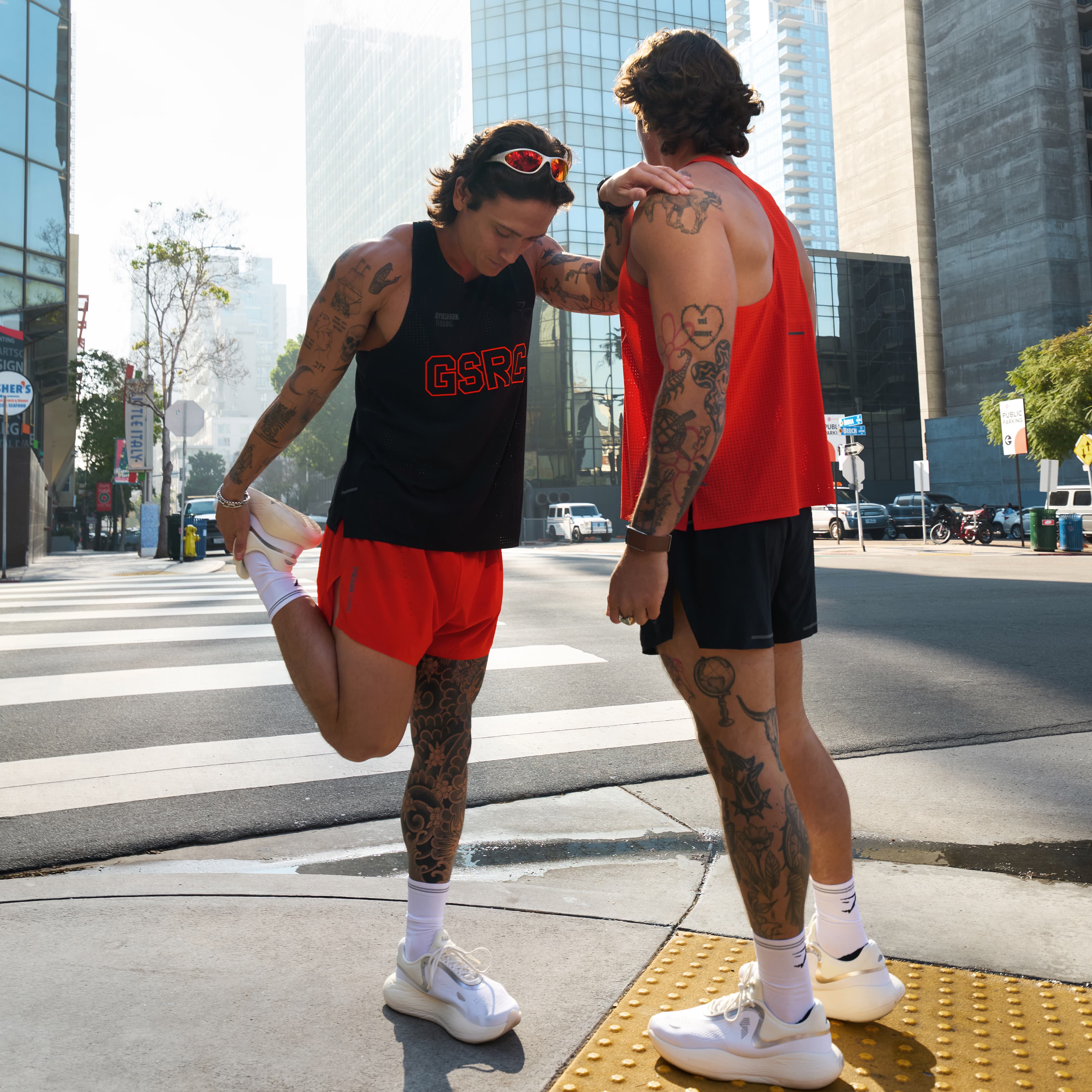



















If you've been going to the gym for some time, you'll likely already be aware of the two types of stretching: dynamic stretching and static stretching.
The former is most commonly done pre-workout, while static stretching is usually kept for post-workout. While this technically isn't incorrect, recent research shows that there's a more efficient way to use stretching to maximize performance and better aid recovery.
Get ready to understand the difference between dynamic vs static stretching–and know exactly when you should use each for the best benefit. We can't promise you'll enjoy stretching any more than before, but using the correct type of stretching at the right time will help you see more significant benefits.
So before you head to the squat rack or load up the plates on the bench press, take a moment to understand your warm-up and stretching routine first—we promise it will make a difference.
Why Is Stretching Important?
We're always told we should stretch, but why? Well, hours of sitting lead to tight muscles. Head straight from your desk or your car into a set of heavy back squats or overhead presses, and you're putting yourself at risk of injury. So many of us do it, which is where stretching can help by getting blood flowing through the muscles and increasing flexibility to improve range of motion. It helps with performing movements properly and lessens the risk of injury.
But that's not all: When used correctly, stretching is also proven to enhance performance, improving everything from power output and strength to running and jumping speed [1].
Sounds great, right? Well, one word of warning: When used incorrectly, stretching might not only be a waste of time but could hinder your performance.
So, how do you ensure stretching benefits you rather than holds you back?
Well, you need to understand the difference between the two main types of stretching—dynamic and static stretching—and when to use them, which we'll cover now.
What Is Dynamic Stretching?
Dynamic stretches are pre-workout stretches, most often performed during a warm-up [1]. They might not be traditionally what you think of as a ‘stretch’, as they have you constantly flowing through a sequence of exercises rather than holding a position.
Dynamic stretches should focus on the muscles used in the main workout to prepare the body for the movements to come. The main focus is to increase blood flow, get oxygen moving through the body, and increase mobility, which can help prevent injury during the workout.
When Should I Use Dynamic Stretches?
It has long been understood that dynamic stretches should be used at the start of a workout during a warm-up [7]. There is little evidence to show any benefits of doing dynamic stretches post-workout.
How Many Dynamic Stretches Should I Do?
Performing dynamic stretches as part of a warm-up doesn't take too long. Four to six exercises, performed for around ten reps each, two to three times round, should be enough.
What Is Static Stretching?
Static stretching is probably the first type of movement that comes to mind when we talk about stretching: think folding over to touch your toes or taking hold of one foot when standing to stretch out your quads after a brutal squat session. Static stretches are held usually for 30 seconds to a minute (but can be longer!).
Active Stretching Vs Passive Stretching
Static stretching can be further divided into two subcategories: active stretching and passive stretching. While the former uses one muscle group to stretch another, the latter uses external forces, such as another part of your body, another person, or a resistance band, to assist the stretch.
For example, standing tall and bending one leg to bring your foot towards your butt would stretch your quad in an active stretch. Placing your hand on your ankle and pulling the foot closer to your butt would increase the stretch and make it into a passive stretch.
Both active and passive stretching will increase flexibility, but passive stretching generally leads to greater improvements in flexibility and range of motion as you can push your muscles further than during an active stretch.
When Should I Use Static Stretches?
There have been some differing opinions over the years as to when static stretches should be performed:
Traditionally, static stretches were included in warm-ups to improve range of motion and prime the muscles for the workout to come. More recently, however, using static stretches during warm-ups has fallen out of favor due to evidence that it decreases performance and strength in subsequent movements [1].
On the other hand, other studies have concluded that static stretches can be included in warm-ups without impacting subsequent strength and power output, as long as they are held for 60 seconds or less, and that this is beneficial due to their positive effect on flexibility and injury prevention [11].
So what about post-workout? This is surely the most obvious time to include static stretches.
Contrary to popular belief, using static stretches post-workout has been found not to help recovery at all, making them pretty pointless when used post-session [12]. If your toxic trait is repeatedly finishing your last set of squats and heading straight out the door, then you'll likely find this welcome news.
Studies suggest that instead of doing static stretches post-workout, you should stretch' independent of other training workouts’ to reap the rewards fully [13]. This could be a rest day or during a separate session from your main workout, where you are fully rested.
How Many Static Stretches Should I Do?
There isn't a set number of static stretches you need to do. However, the American College of Sports Medicine recommends performing static stretches 2 to 3 times a week, holding each stretch for 10 to 30 seconds [14].
Dynamic Vs Static Stretching: What’s The Difference?
Dynamic stretches aim to improve circulation, enhance performance and reduce injury risk, whereas static stretches increase flexibility and aid recovery by allowing the muscle to relax and release in its lengthened position.
Benefits Of Dynamic Stretching:
Warms up the muscles by improving blood circulation.
Increase ROM and decrease stiffness when used as part of a warm-up [2].
Found to result in sustained power, strength, muscular endurance, and anaerobic capacity [5].
Reduces the chance of injury by as much as 30% [6].
Benefits Of Static Stretching:
Increased ROM [1].
Improvements in flexibility [8].
It improves blood circulation to help muscles recover more quickly when done daily [9].
Reduces muscle stiffness in tight muscles [10].
Dynamic Stretching Examples
The dynamic stretches you select for your warm up should mirror the muscles/movements you'll use in your main workout. For example, if you're warming up for squats, include some Bootstrapper Squats to warm up your hamstrings, quads, and hips, Calf Raises to mobilize the ankles, and 90-90’s to open up your hips. You need to think about your main workout and ensure each body part is prepared for the following movements.
Other dynamic stretches include:
Cat-Cow Pose (stretches and warms up the spine, helping to prevent back strain or pain. An excellent option to warm up before any back-loaded movements or overhead pressing, where the back is at risk oWorld'sn.)
World's Greatest Stretch (This is a great full-body dynamic stretch that warms up the core, hamstrings, calves, glutes, quads, back, chest, shoulders, and arms! It's an excellent primer for any workout, especially if you've been sitting at a desk all day.)
Inchworms (another full body dynamic stretch, working the shoulders, triceps, chest, glutes, hamstrings, and core.)
Lunges (warm up the glutes, hip flexors, and hamstrings and activate the core, making them an excellent warm-up for running or a lower-body strength session).
Looking for more ideas? Try our Best 7 Exercises To Add To Your Leg Day Warm Up.
Static Stretching Examples
Static stretches may be less specific but may focus on muscle groups worked in recent workouts or any areas that feel tight or stiff.
Couch Stretch (This is a great stretch to relieve tightness in the hips. It improves mobility in the back, core, and hips, making it ideal if you spend most of your day sitting down.)
Standing Hamstring Stretch (If you’ve had a heavy deadlift session or been on a run, this stretch will relieve tightness in the hamstrings and stretch out the lower back.)
Pigeon Pose (Opens the hips and stretches out the hip flexors and lower back, which are often tight from sitting down.)
Lying Pec Stretch (This is an excellent stretch if you're feeling tight after chest day. The lying pec stretch allows you to stretch each shoulder and side of the chest individually.)
. . .
Dynamic Vs Static Stretching: Which Should You Choose?
Before your workout, opt for mainly dynamic stretches (but you can include a few static ones, as long as these are held for less than 60 seconds). This will improve circulation, enhance performance, and reduce injury risk.
You can include static stretches after your workout if you want to. However, recent studies have concluded that this does little to help recovery.
On rest days or between workouts, do some static stretches at least two to three times a week. This will help improve your flexibility, help your muscles move with increased ROM, alleviate stiffness, and aid recovery. (Looking for something to wear on your rest day? Shop our Rest Day Outfits)
You're unlikely to encounter many people who enjoy stretching. Still, if you follow the above, you should be able to incorporate stretching into your workout routine in a manageable way. So next time you think about swerving your stretching in favor of getting on with your workout, think twice–it's worth giving them a little time in your day.
. . .
References:
Page, P. (2012). Current concepts in muscle stretching for exercise and rehabilitation. International journal of sports physical therapy, [online] 7(1), pp.109–19. Available at: https://www.ncbi.nlm.nih.gov/pmc/articles/PMC3273886/.
Iwata, M., Yamamoto, A., Matsuo, S., Hatano, G., Miyazaki, M., Fukaya, T., Fujiwara, M., Asai, Y. and Suzuki, S. (2019). Dynamic Stretching Has Sustained Effects on Range of Motion and Passive Stiffness of the Hamstring Muscles. Journal of sports science & medicine, [online] 18(1), pp.13–20. Available at: https://www.ncbi.nlm.nih.gov/pmc/articles/PMC6370952/.
Hough, P.A., Ross, E.Z. and Howatson, G. (2009). Effects of Dynamic and Static Stretching on Vertical Jump Performance and Electromyographic Activity. Journal of Strength and Conditioning Research, [online] 23(2), pp.507–512. doi:https://doi.org/10.1519/jsc.0b013e31818cc65d.
Fletcher, I.M. and Anness, R. (2007). The Acute Effects of Combined Static and Dynamic Stretch Protocols on Fifty-Meter Sprint Performance in Track-and-Field Athletes. The Journal of Strength and Conditioning Research, 21(3), p.784. doi:https://doi.org/10.1519/r-19475.1.
Herman, S.L. and Smith, D.T. (2008). Four-Week Dynamic Stretching Warm-up Intervention Elicits Longer-Term Performance Benefits. Journal of Strength and Conditioning Research, 22(4), pp.1286–1297. doi:https://doi.org/10.1519/jsc.0b013e318173da50.
Sadigursky, D., Braid, J.A., De Lira, D.N.L., Machado, B.A.B., Carneiro, R.J.F. and Colavolpe, P.O. (2017). The FIFA 11+ Injury Prevention Program for Soccer players: a Systematic Review. BMC Sports Science, Medicine and Rehabilitation, [online] 9(1). doi:https://doi.org/10.1186/s13102-017-0083-z.
Esteban-García, P., Abián-Vicen, J., Sánchez-Infante, J., Ramírez-delaCruz, M. and Rubio-Arias, J.Á. (2024). Does the Inclusion of Static or Dynamic Stretching in the Warm-Up Routine Improve Jump Height and ROM in Physically Active Individuals? A Systematic Review with Meta-Analysis. Applied Sciences, [online] 14(9), p.3872. doi:https://doi.org/10.3390/app14093872.
Arntz, F., Markov, A., Behm, D.G., Behrens, M., Negra, Y., Nakamura, M., Moran, J. and Chaabene, H. (2023). Chronic Effects of Static Stretching Exercises on Muscle Strength and Power in Healthy Individuals Across the Lifespan: A Systematic Review with Multi-level Meta-analysis. Sports Medicine, 53. doi:https://doi.org/10.1007/s40279-022-01806-9.
Hotta, K., Behnke, B.J., Arjmandi, B., Ghosh, P., Chen, B., Brooks, R., Maraj, J.J., Elam, M.L., Maher, P., Kurien, D., Churchill, A., Sepulveda, J.L., Kabolowsky, M.B., Christou, D.D. and Muller-Delp, J.M. (2018). Daily muscle stretching enhances blood flow, endothelial function, capillarity, vascular volume and connectivity in aged skeletal muscle. The Journal of physiology, [online] 596(10), pp.1903–1917. doi:https://doi.org/10.1113/JP275459.
Nakamura, M., Ikezoe, T., Kobayashi, T., Umegaki, H., Takeno, Y., Nishishita, S. and Ichihashi, N. (2014). Acute Effects of Static Stretching on Muscle Hardness of the Medial Gastrocnemius Muscle Belly in Humans: An Ultrasonic Shear-Wave Elastography Study. Ultrasound in Medicine & Biology, 40(9), pp.1991–1997. doi:https://doi.org/10.1016/j.ultrasmedbio.2014.03.024.
Chaabene, H., Behm, D.G., Negra, Y. and Granacher, U. (2019). Acute Effects of Static Stretching on Muscle Strength and Power: An Attempt to Clarify Previous Caveats. Frontiers in Physiology, [online] 10(1468). doi:https://doi.org/10.3389/fphys.2019.01468.
Afonso, J., Clemente, F.M., Nakamura, F.Y., Morouço, P., Sarmento, H., Inman, R.A. and Ramirez-Campillo, R. (2021). The Effectiveness of Post-exercise Stretching in Short-Term and Delayed Recovery of Strength, Range of Motion and Delayed Onset Muscle Soreness: a Systematic Review and Meta-Analysis of Randomized Controlled Trials. Frontiers in Physiology, [online] 12. doi:https://doi.org/10.3389/fphys.2021.677581.
Behm, D.G. and Chaouachi, A. (2011). A Review of the Acute Effects of Static and Dynamic Stretching on Performance. European Journal of Applied Physiology, [online] 111(11), pp.2633–51. doi:https://doi.org/10.1007/s00421-011-1879-2.
ACSM_CMS. (2021). ACSM Blog. [online] Available at: https://www.acsm.org/blog-detail/acsm-certified-blog/2021/03/18/stretching-and-flexibility-guidelines-update